April 26th, 2016

When a child is born, he or she will have 20 primary teeth and 32 permanent teeth. But sometimes kids are born with additional teeth, and our team at Prairie Ridge Orthodontics calls this oral condition "hyperdontia." Primary teeth are the first set of teeth that erupt in your child's mouth, typically by the time they are 36 months old, and are shed by the time your child reaches the age of 12. Permanent teeth then take the place of the primary teeth and are usually fully-erupted by the time your son or daughter reaches 21 years of age. Anyone who develops more than 20 primary teeth or more than 32 permanent teeth has hyperdontia, and the additional teeth are referred to as supernumerary teeth.
While the cause of hyperdontia is not entirely clear, it is believed that there may be a genetic factor. Oral professionals have found that patients with extra teeth often have syndromes like cleidocranial dysplasia, Ehler-Danlos syndrome, Gardner syndrome, or cleft lip and palate. The prevalence of hyperdontia affects between one and four percent of the population in the United States, and the majority of cases are limited to a single tooth.
So, what is the best way to deal with hyperdontia? It really depends on the case. The treatment plan your doctor suggests varies according to the potential problem posed by the supernumerary teeth, as well as their type. Orthodontic treatment may certainly may help, but extraction can also be a good option. We recommend that children receive an oral evaluation or checkup no later than the age of seven. In addition to hygiene evaluation, this helps ensure your child does not experience hyperdontia problems.
If you suspect you or your child may be suffering from hyperdontia, please give us a call to schedule an appointment at our convenient Faribault, Zumbrota, or Owatonna, MN office to be evaluated.
April 19th, 2016

During the early days of the environmental awareness movement, those who demonstrated against pollution, toxic chemicals, and the general public health were known as hippies. The early 1970s were a time of change, and assertions that we needed to pay more attention to the Earth's atmosphere were generally dismissed. But within a couple decades, it had become clear that the previous generation was right; the citizens of the world needed to become more environmentally conscious.
Many people feel that they can't make a difference if they don't do something big. But caring for the environment doesn't have to be an all-or-nothing concept. In fact, the little things you do can add up to make a great impact, especially in our community. Here are a few ways you can help the environment on Earth Day, April 22nd and all year around.
Four Small Ways to be Environmentally Friendly
- Recycle Your Textiles. Nearly 21 million tons of textiles are added to American landfills each year, according to the Environmental Protection Agency. Donating your unwanted clothing to a secondhand store or an organization that repurposes fabric helps cut down on solid waste and conserves natural resources.
- Reduce Usage of Disposables. Plastic bottles and bags, disposable diapers and other things we can use and toss out are convenient, but they're not necessary. Simply choosing to replace one of type of disposable with a reusable product can help you cut down on waste that has a large negative impact on our environment.
- Conserve Water. If everyone in the United States turned off the water while brushing their teeth, more than 1.5 million gallons of water could be conserved. Turn the water on long enough to wet your toothbrush for brushing and rinsing, and then immediately turn the water off again.
- Turn Off the Lights. Flip the light switch to "Off" if you're going to leave a particular room for 15 minutes or more. This will conserve energy on incandescent light bulbs and cut down on cooling costs.
It's not necessary to be an activist or install solar panels all over your home to help the environment. Although you can do these things, the little everyday measures make a big difference in helping to conserve energy and the environment, while reducing your carbon footprint. Our team at Prairie Ridge Orthodontics wants to remind you to celebrate Earth Day and help the environment, knowing that it will benefit your and your children's generation.
April 12th, 2016

Your first few days with braces will feel rather odd, awkward, and even painful. The day you get your braces you will probably just feel weird, like you have something in your mouth – because you do. You are most likely to feel pain and soreness during the second and third days. After that, you should be fine. If you experience any pain with your braces, there are a few things you can do to get some relief.
Home Remedies
Rinsing your mouth with warm salt water will soothe it and promote healing. Rinse several times a day or when your mouth, particularly mouth sores, are hurting. You can also take some Tylenol every four hours. Dr. Jeff Loveless and our team advise against products that contain ibuprofen because it slows down the movement of your teeth.
You can also eat cold foods like ice cream or yogurt. The cold of the food will help dull the pain. Ice packs applied to your mouth help as well. You can also swish ice water around your mouth, but DO NOT eat ice!
Cool Products
Products for canker sores can be applied to the mouth sores you develop from your braces. There are also various rinses you can use that act as a shield or barrier in your mouth, and protect your mouth sores from further irritation.
Dr. Jeff Loveless and our team may have given you some dental wax to put on the abrasive areas of your braces to protect your mouth. Putting dental wax on the brackets creates a barrier that keeps your mouth from getting scraped and sore.
Bite wafers are another great pain relief too. When you bite down on the wafer, it increases circulation in your gums, which can ease the pain a bit. Just a little pressure will work; you don’t want to bite too hard. And they usually come in cool colors, too!
The pain won’t last forever. One day you will wake up and you won’t have any pain. In fact, you probably won’t even notice the braces in your mouth at all!
April 5th, 2016
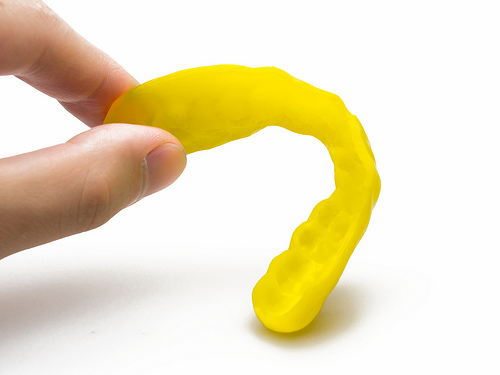
It's springtime and it's again time to remind our patients at Prairie Ridge Orthodontics to protect their faces and pearly whites while out on the field playing sports. According to the National Youth Sports Safety Foundation, children, high-school athletes and adults have more than 5,000,000 teeth knocked out in sporting events annually.
If you are planning on participating in spring sports, it’s imperative to have a proper-fitting mouthguard. Mouthguards can prevent chipped or broken teeth, lip and cheek injuries, jaw fractures, mouth lacerations and even concussions.
Having a mouthguard can make the difference between losing your teeth or not, and because many of our patients who play high school sports have jaws that are still growing, last year’s mouthguard may no longer fit as it should. Dr. Jeff Loveless and our team at Prairie Ridge Orthodontics can fit you for a new guard.
To learn more about mouthguards or for general questions about your treatment at our Faribault, Zumbrota, or Owatonna, MN office, please give us a call!

